The published serving guide
Getting the amount right is one of the simplest and most useful things you can do. The published guide is based on your dog's weight and has just three ranges:
| Your dog's weight | Daily serving |
|---|---|
| Under 30 lb | ½ tablet daily |
| 30–75 lb | 1 tablet daily |
| Over 75 lb | 1½ tablets daily |
That is the whole guide. Please follow it as written and do not adjust the amount on your own. If you think your dog needs something different, that is a conversation for your vet.
How to weigh your dog
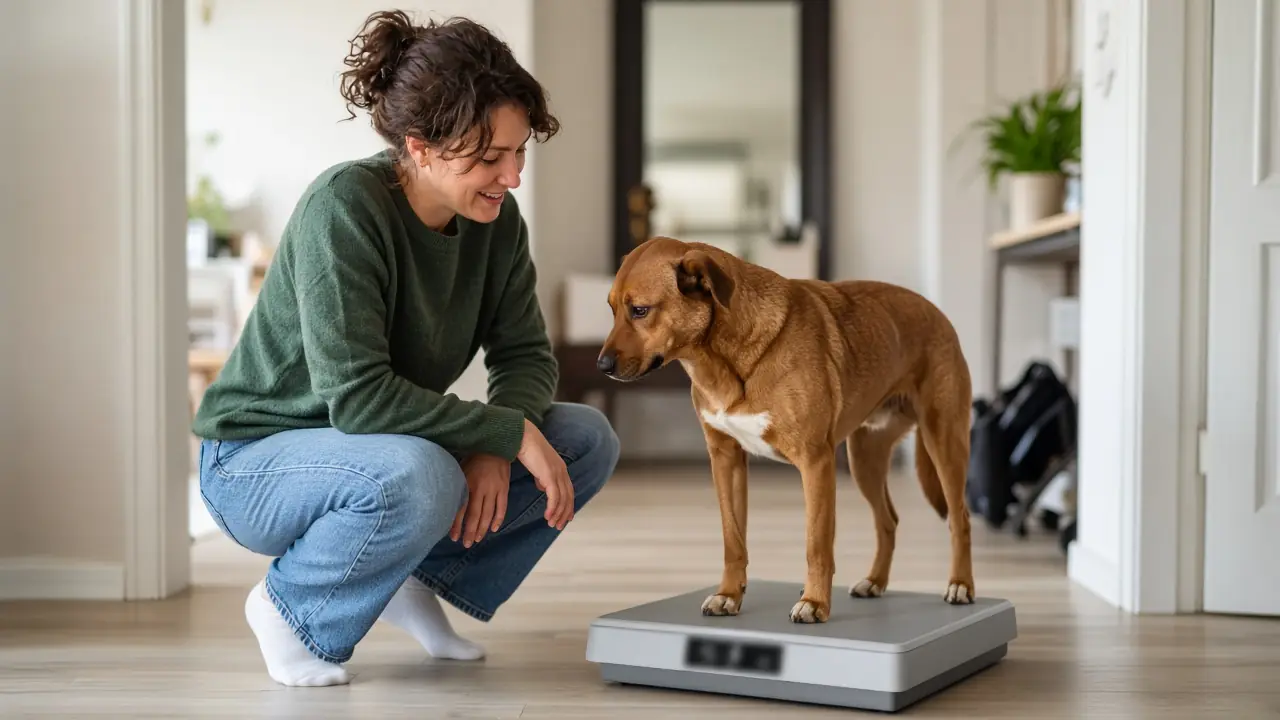
To use the table, you need a recent weight. Guessing is easy to get wrong, especially with fluffy coats or dogs that have changed size over the past year. Here are a few ways to get a real number:
- At home with a bathroom scale: weigh yourself, then weigh yourself holding your dog. Subtract the first number from the second.
- Small dogs: place a basket or box on a kitchen or bathroom scale, zero it out, then set your dog inside.
- Larger dogs: ask your vet's office if you can use their scale. Many are happy to let you stop in for a quick weigh-in.
Write the weight down with the date. Check it again every few months, or any time you notice your dog looks bigger or smaller, so you are always reading the right row.
Splitting a tablet
If your dog is under 30 lb or over 75 lb, you will be working with half a tablet. A few tips make it easy:
- Use a clean, sharp knife or an inexpensive tablet splitter from a household-goods store.
- Split on a clean, dry cutting board, pressing straight down rather than sawing.
- For dogs under 30 lb, give one half today and save the other half for tomorrow.
- For dogs over 75 lb, give one whole tablet plus one half.
- Put any leftover half back in the sealed container, or in a small sealed bag inside it, and use it the next day.
Halves will not always be perfectly even. That is fine. Do your best and aim to keep the routine steady from day to day.
Keeping it consistent
Consistency matters more than precision. Pick a time that fits your day, such as breakfast or the evening meal, and stick with it. Tie the tablet to something you already do every day so it becomes automatic.
A few simple tools help:
- A sticky note on the food bin or a reminder on your phone.
- A small notebook or calendar where you tick off each day.
- One person in the household in charge, so your dog does not get a second serving from someone else.
If you miss a serving
Life happens. If you forget a day, simply pick up again the next day with the normal amount. Never double up to make up for a missed serving. Just continue with the usual serving from the table, at the usual time.
If you realize later the same day, you can give the normal serving then. If it is already close to the next day's serving, skip the missed one and carry on as usual.
When to check with your vet first
The table covers most dogs, but some situations call for a quick word with your vet before you start:
- Very small dogs, near the bottom of the under 30 lb range.
- Very large dogs, well over 75 lb.
- Young dogs and puppies.
- Pregnant or nursing dogs.
- Any dog whose weight is changing quickly.
Bring the label and your dog's latest weight. Our list of questions to ask your vet can help you prepare, and introducing a new supplement covers the first few days. If you are still deciding on a product, see how to choose a pet supplement.
Ready to try it?
SlowChew makes a daily flavored tablet with an advanced peptide formula, served by your dog's weight.
Keep reading

What Are Pet Peptides? A Plain-Language Guide
Short chains, simple idea: the background every dog owner can use when reading a peptide label.
Read the guide →
How to Choose a Pet Supplement for Your Dog
Six practical checks that help you pick a product, and a company, you can actually trust.
Read the guide →
How to Read a Supplement Label and a COA
The paperwork behind a supplement is less mysterious than it looks, and it tells you a lot.
Read the guide →